
RTDs.
More accurate and repeatable over long periods than thermocouples, bi-metal thermometers or thermistors — RTDs are the right choice when stability and precision matter most.
Precision & Repeatability
Five RTD families for every process and installation
From quick-disconnect immersion probes to drilled-bar industrial wells, sanitary pharmaceutical sensors and custom multipoint assemblies — every RTD is built to your application and backed by our quality program.
Immersion RTDs
Platinum probes with a range of terminations — Ø 1/8″–1/4″, 100 Ω @ 0°C, 316 SS
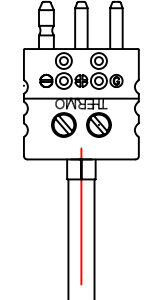
Quick Disconnect Connector
A quick-disconnect connector secured to the end of the sheath allows easy assembly and disassembly using a mating connector and extension.
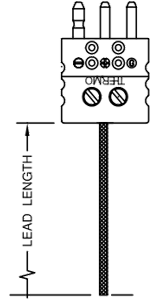
Lead Wire
Flexible fiberglass or Teflon® insulated lead wire with an epoxy-filled transition for a direct run from process to panel. Fiberglass is unaffected to 950°F; Teflon adds corrosive protection to 500°F.
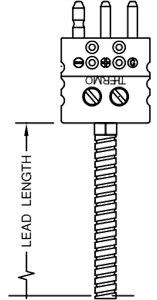
Armored Lead Wire
Fiberglass or Teflon® lead wire with a flexible stainless armor tube overall, hex-crimped to the transition to resist extreme physical abuse. Connector or bare-end termination.

Field Adjustable Probes
A thin-film bulb calibrated to ASTM Class B or Class A accuracy with excellent vibration resistance and fast response. Stocked in 1/4″ O.D., 28.5″ long, with a 316 SS sheath that cuts easily to length.
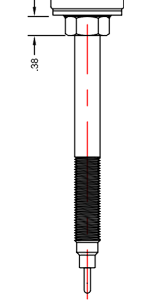
Plastic Melt Probes
Plastic-melt bolt for extruders and injection-molding machines. The connection inserts directly into the melt stream, and the short immersion length keeps the tip from interfering with process flow.

Fixed Fittings
Single- or double-ended fittings give a watertight connection into the process and accept conduit, junction boxes, connection heads or a transmitter. Compression fittings are available for mounting.
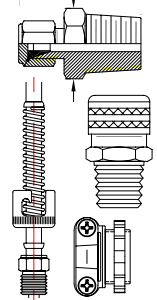
Accessories & Fittings
A complete supply of stainless-steel or brass fittings to mount any immersion RTD into an NPT opening, adjustable once or readjusted using Teflon® or Lava ferrules.
Surface Probes
Bayonet and gasket RTDs plus mounting adapters for surface measurement
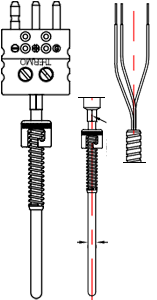
Bayonet Probes
A specially constructed tip-sensitive bulb provides quick surface response. Available with connector or lead-wire termination.
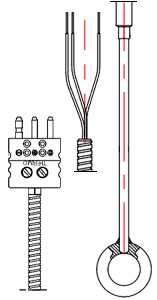
Gasket Probes
Attached to a welded stud or with a nut and bolt, with the RTD bulb embedded in the gasket. Most often used to monitor surface temperature of machinery and engines.
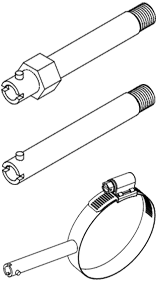
Bayonet Adaptors
Surface-mounting or pipe-clamp adapters in variable lengths and diameters allow attachment of any bayonet thermocouple or RTD.
Industrial RTDs
Drilled-bar well assemblies — Pt / Cu / Ni elements, −180 to 650°C, heads NEMA-4/4X, FM, CSA, ATEX

Drilled Threaded — Tapered & Straight
The most common well style. The threaded well inserts directly into process lines through pipe tees or laterals, or into tanks via half-couplings. Straight shank for longer wear; tapered to limit flow restriction.

Alloy Metals — Tapered
For corrosive environments or where extra strength is required. Fabricated in austenitic, ferritic or martensitic stainless steels, nickel alloys, chrome-molys and other specialty metals, with machined wrench flats.

Stepped Down Shank
A stepped-down shank gives a reduced wall thickness over the last 2 1/2″ of well length, improving the RTD element's response time. Shorter wells use the 1/2″ step for the entire shank.

Socket & Weld-In Bar Stock
For high-temperature, high-pressure service — most often steam — where leak-proof permanent connections are mandatory. Socket wells insert via tees or branch lines; weld-in wells weld directly into heavy-wall tanks.

Drilled Flanged — Tapered, Straight, Stepped
Forged flanges in many sizes, ratings and facings mate to existing process flanges in pipelines or welding-neck flanges on reactors and tanks. Available in raised-face, flat-face and ring-joint, welded both sides.

More Well Styles
Van Stone and additional well configurations, connection heads (aluminum, stainless, cast iron or polypropylene) and head certifications are detailed in the Designer's Guide.
Pharmaceutical & Biotech
Sanitary CIP / bevel-seat RTDs & thermocouples (CEPC) — 100 Ω Pt or base-metal, Ø .25″
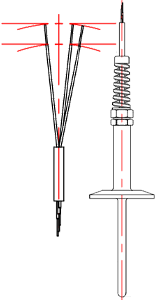
Teflon Lead Wire (CEPC)
One of the most common sanitary styles, in any immersion length and a range of mating connections. Element conductors terminate in an epoxy-sealed transition to Teflon-insulated, jacketed lead wires, with a nylon cord grip for strain relief.
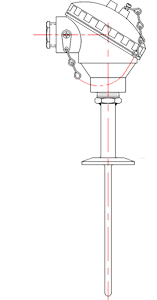
Connection Head (CEPC)
Termination to an FDA-approved polypropylene, NEMA-4 aluminum or NEMA-4X stainless head for added protection in industrial environments — with a captive-chain screw cover and brass terminal posts on a ceramic base.
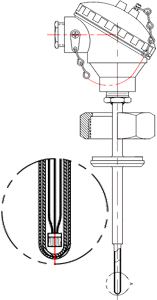
Head & Thermowell (CEPC)
Complete with connection head, sensor and a reduced-tip well for faster response — allowing the sensor to be removed without breaking the sanitary process seal.
Multipoint
Multipoint temperature profiles across a tank or vessel
A multipoint assembly arranges multiple measuring junctions at various depths so you can monitor a full temperature profile from one unit — used in catalytic crackers, lime kilns, distillation columns and pressurized reactor vessels. Assemblies range from miniaturized three-foot units with two or three sensors to runs over a hundred feet with twelve or more.
Each typically combines a junction box, the depth-staged RTDs (or thermocouples), and a pipe protection well rated for the vessel's pressures and corrosives. Multipoints are custom-made to place junctions at the key points in your process, and our applications engineers can assist with the design.

Multipoint Configurations
Free-hanging, spring-loaded and multitube assemblies, miniature profiling units, and averaging / swamping boxes — detailed in the Designer's Guide.
Need a specific RTD?
Every RTD is built to your application. Tell us about your process and our team will help you specify the right probe or assembly — or browse the full product guide.